
What is already on file in Germany
Germany’s Federal Institute for Risk Assessment, the BfR, recommends that any food above 100 mg of capsaicin per kilogram carries a warning label and a child-safe closure.[1] That opinion was published in 2011 and restated in November 2023.[2]
100 mg/kg sits below a fresh green jalapeño, which BfR’s own comparison table puts at up to 500 mg/kg.[1]On that threshold, a mild jalapeño sauce needs a child-safe cap. So does most of what is on a European shelf.
For twelve years nothing followed from it. Then came the Hot Chip Challenge. Between 2021 and 2023 Germany’s poison information centres recorded 73 enquiries involving 77 patients. Thirty-seven were linked to the challenge, almost all of them children and adolescents.[2] BfR restated the recommendation, then published a full toxicological assessment in June 2024.[3]
And that assessment says the evidence is not there yet. In its own words, the available data do not permit a classical risk assessment or the derivation of a health-based guideline value.[3] A recommendation exists. The science to calibrate it does not.
Why that is dangerous rather than merely untidy
Imagine the next incident is worse. A child is seriously harmed. The story runs nationally. Ministers are asked what they are doing about extremely hot food, and regulators have to answer quickly. They know there is a problem. They have evidence of harm. What they do not have is an agreed way to tell a normal culinary hot sauce from an extract-heavy challenge product.
When pressure is high and evidence is incomplete, simple rules are much easier to write than nuanced ones. A blanket restriction. A very low threshold. Packaging requirements designed around the most extreme products and applied to everything beneath them.
Regulation does not ban flavour. It prices it. A packaging rule is a fixed cost, and a fixed cost lands very differently on a producer filling 2,000 bottles than on one filling two million. That is how a category quietly narrows: not by decision, but because the people least able to absorb another test stop being viable.
There is a defence sitting in the same document. BfR’s 2011 opinion states that sauces up to 6,000 mg of total capsaicin per kilogram, roughly 100,000 Scoville, still correspond to traditionally accepted levels of heat.[1] Almost no craft sauce comes near it. The industry has never once said so out loud, in public, with evidence attached.
The Council’s answer: the Heat Mark
We are not proposing to fight regulation. We are proposing to supply the thing it is missing: a graded, testable, industry-written classification that a consumer can read in one second and a regulator can point at.
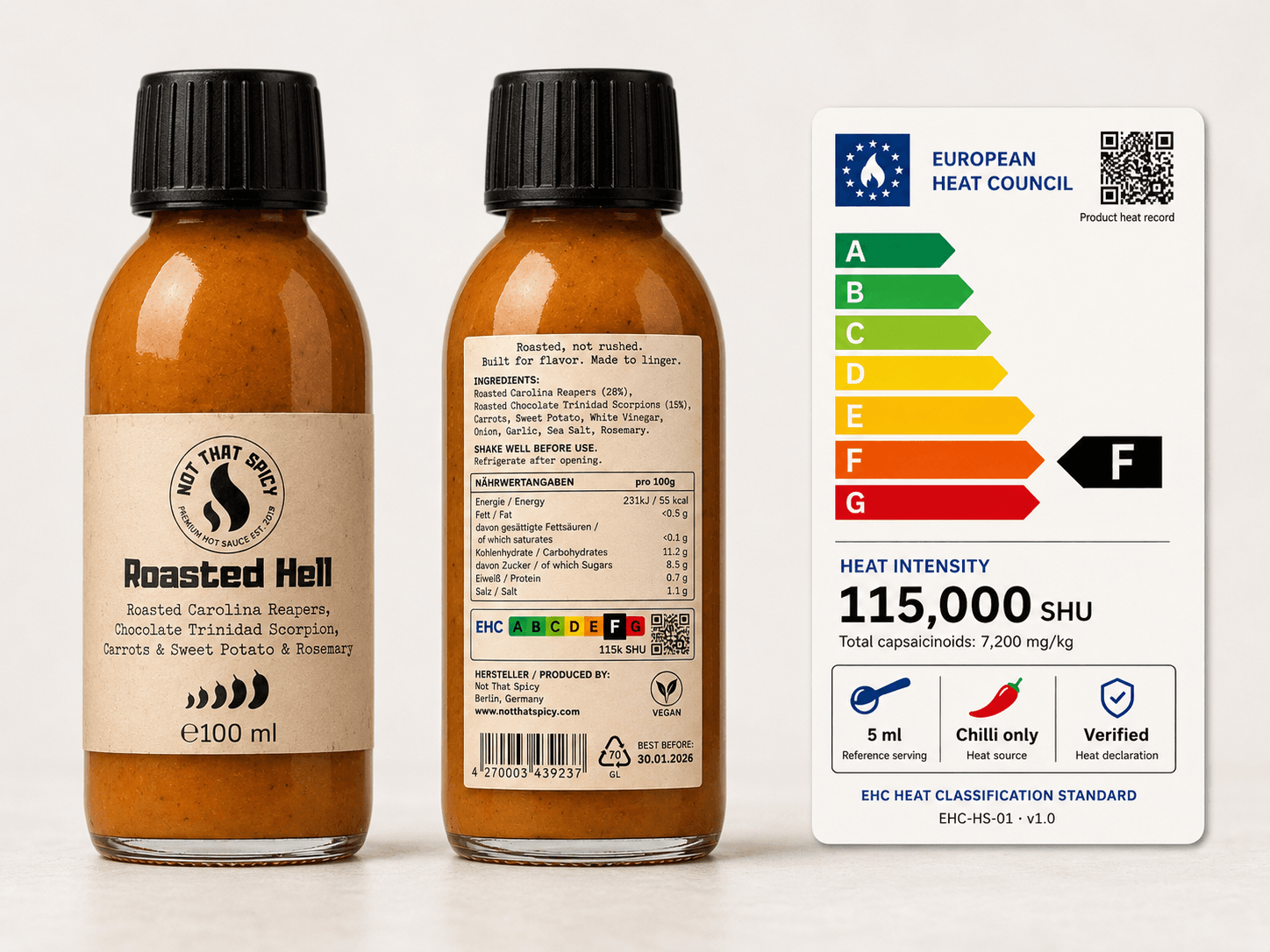
It borrows a format every European shopper already understands. Seven classes, A to G, from mild to extreme, printed on the back of the bottle with the measured heat behind it and a code that opens the full record.
Mild
Everyday heat. The sauces most people eat most of the time, and the part of the category that has no business carrying a warning label.
Hot
Proper heat. A customer who wants this can find it, and a customer who does not can avoid it, which is the entire job a scale has to do.
Extreme
Serious heat, still sold as food and still eaten as food. Made by people who know what they are doing, for people who know what they are ordering.
Extreme heat, enhanced consumer guidance
This is the part that matters to a regulator. G+ is where extract-led products sit: the ones sold to be endured rather than eaten. It gives the state a line it can regulate against without touching the jalapeño sauce underneath it. Right now no such line exists, which is why the only available rule is one that catches everything.
How far the draft has actually got
Drafted, and the part we are most confident in: the format, the A to G structure, the G+ designation, the published heat record behind a code, a fixed reference serving, and a declaration of the heat source so a sauce carrying pepper extract cannot hide behind a pod. Confident is not the same as fixed. Any of it can change on a good argument.
Open, and deliberately not published here: the capsaicinoid figure at each band boundary. Publishing a number before it is agreed means a maker prints it on a label, and a scale that moves after printing is worse than no scale. Two things have to close first. BfR’s 100 mg/kg recommendation is written in capsaicin while its 6,000 mg/kg figure is written in total capsaicinoids, and the two are not the same measurement.[1] And laboratory heat is not perceived heat: fat, sugar, salt and acid all mask burn, so a sweet 30,000 SHU sauce can eat milder than a thin 15,000 one.
The fix for the second one is the reason this proposal comes from us rather than from anybody else. Analytical bands, plus a trained sensory panel on the borderline cases. The European Hot Sauce Awards judging panel already exists, has already tasted across the category, and no other body proposing a heat scale in Europe can build one.
Founding members see the draft thresholds, argue about them, and settle them. That is not a courtesy. A standard nobody had a hand in is a standard nobody adopts.
We are not asking for a new rule
European food law already says that voluntary information on a label must not mislead and must rest on relevant scientific data.[4]On that reading, “extra hot” printed on a 3,000 SHU sauce is already questionable. It is simply unenforceable, because there is no benchmark to measure it against.
So the Council is not asking a regulator to write anything. It is supplying the missing definition that an existing rule needs, and doing it in the one place the evidence actually lives: with the people who make the sauce.
The rest of the work
Standards are one half. The other half is being in the room when rules are written, which is a slower and much less photogenic job.
Eleven position papers are published and open to anyone, covering what an independent producer is, proportionate food safety, ingredient provenance, regional supply chains, shipping rates, energy costs, packaging, novel food authorisation, geographical indications, deforestation traceability, and the research record on chilli itself. Read the positions.
On packaging, the work is already live. Regulation (EU) 2025/40 took effect on 12 August 2026 and stops most independent makers selling into another EU country without a registered representative in each one. What changed, what it costs, and what the Council is building instead.
Two letters are drafted and waiting for names. One to the BfR on the evidence behind its recommendation. One to the BMEL offering this scale, before somebody who has never made a sauce sets one for us. A letter from three people is a letter. A letter from three hundred producers is a stakeholder.
You see the draft. Your name is on it. You get the reply.
It is time we take back what “hot” actually means.
A consumer should be able to look at a bottle and understand what hot means. Not because somebody wrote EXTRA HOT on a tube of crisps. But we can only do that if we stop acting like hundreds of unrelated businesses and start behaving like an industry.
Founding membership is €150 a year, the same price for everyone, invoiced once the Council legally exists.
Sources
- [1]BfR, Stellungnahme 053/2011, 18 October 2011 — the 100 mg/kg capsaicin labelling and child-safe closure recommendation, and the separate 6,000 mg/kg total capsaicin threshold. Source
- [2]BfR, Mitteilung 39/2023, updated 20 November 2023 — the recommendation restated after the Hot Chip Challenge. Source
- [3]BfR, Opinion 027/2024, 21 June 2024 — full toxicological assessment. States that the available data do not permit the derivation of a health-based guideline value. Source
- [4]Regulation (EU) No 1169/2011 on food information to consumers, Article 36 — voluntary food information must not mislead and must be based on relevant scientific data. Source
EHC-HS-01 is a working draft published for comment, not a finished standard. It is not a legal requirement, it confers nothing, and nothing on this page is legal advice. The classes shown in the artwork are illustrative and the band thresholds are not set. No product should be labelled against any of it yet. When it is settled, it will say so here and it will say who settled it.